Loan Amortization Explained: Why Your Early Payments Barely Touch the Principal
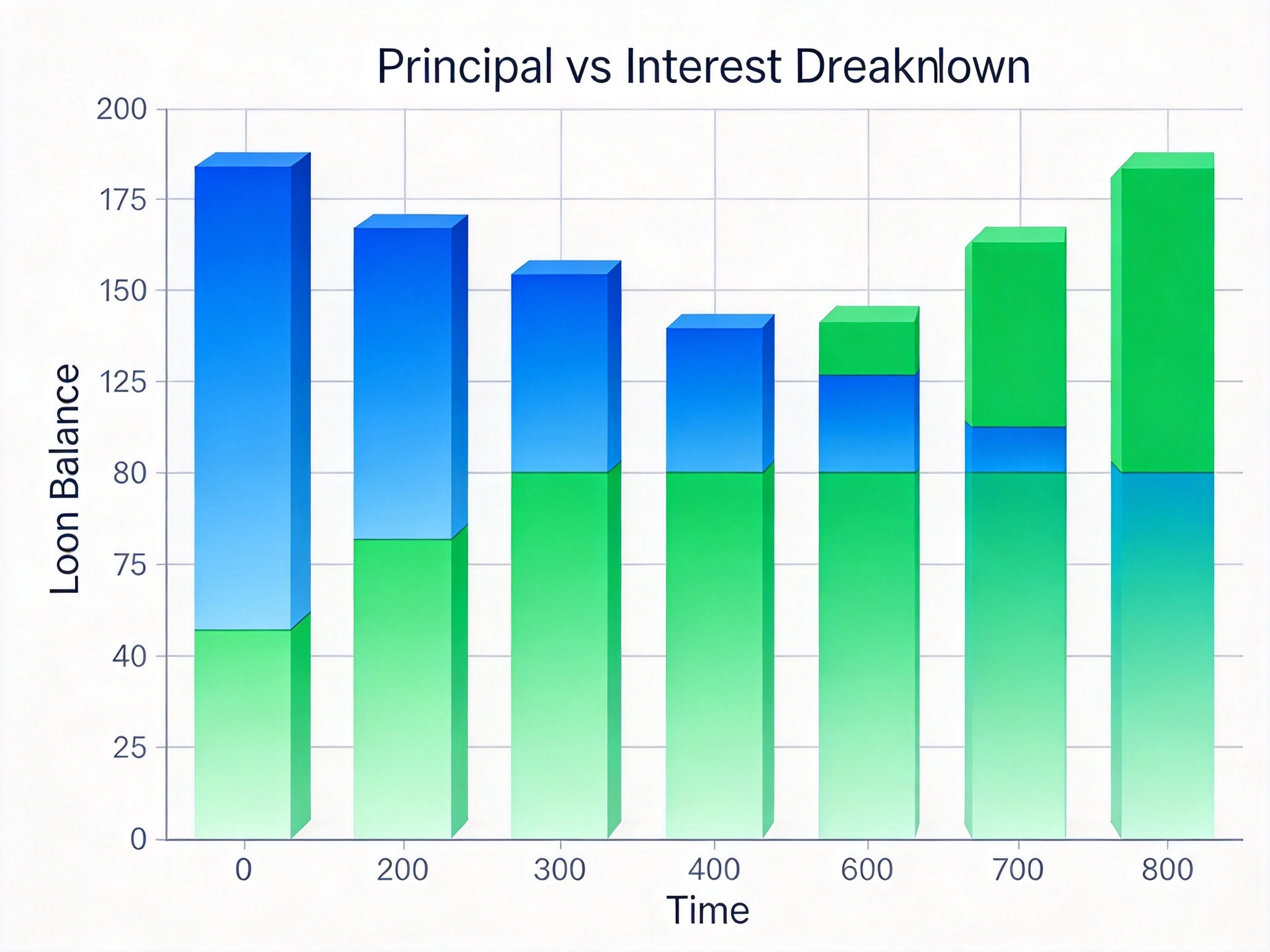
When I got my first car loan, I made 12 months of payments — about $4,800 total — and checked my balance. I'd knocked off roughly $2,100 from what I owed. Where did the other $2,700 go? Straight to the bank as interest.
That sinking feeling isn't unique to me. It's baked into how virtually every installment loan works: amortization. And while the math behind it is straightforward, the emotional impact of watching your early payments evaporate into interest charges never really goes away.
Let me break down exactly how amortization works, why it's designed this way, and what you can actually do about it.
What Amortization Actually Means
Amortization is just the process of spreading a loan into a series of fixed payments. Each payment covers two things: interest on the remaining balance, and a portion of the principal (the original amount you borrowed).
Your monthly payment stays the same for the entire term. But the split between interest and principal changes every single month. Early on, most of your payment goes to interest. As the balance shrinks, the interest portion shrinks too, and more of your payment attacks the principal.
This isn't a scam. It's simple math: interest is calculated on the outstanding balance. When your balance is high (like at the beginning of a 30-year mortgage), the interest charge is high. When your balance is low, the interest charge is low.
The Numbers That Hurt
Let me show you what this looks like with a real example. Say you take out a $300,000 mortgage at 6.5% interest over 30 years. Your monthly payment is $1,896.
Here's where your first payment goes:
- Interest: $1,625 (the bank's cut)
- Principal: $271 (actually reducing your debt)
That means 85.7% of your first payment is pure interest. You're paying almost $1,900 and your loan balance drops by less than $300. That's brutal.
Fast forward to year 15 (halfway through the loan). You've made 180 payments totaling about $341,280. Your remaining balance? Roughly $207,000. You've paid off only about $93,000 of the original $300,000 — less than a third — and you've already spent more in interest than the principal you've retired.
It gets better in the later years. Your last payment might be $1,890 in principal and just $6 in interest. But by then, you've already paid around $382,000 in total interest on a $300,000 loan. You bought the house twice and then some.
Why It's Designed This Way
Banks aren't being evil here. Amortization is the only way to make fixed payments work. Think about it: if you paid equal amounts of principal each month, your first payment would be much higher (because you'd need to cover a large interest charge plus an equal principal portion), and your last payment would be tiny.
Most people can't afford a $3,000 payment in year one that drops to $1,000 by year 30. Fixed payments make budgeting possible. The tradeoff is that you pay more interest upfront.
There's also a less generous reason: it benefits the lender. Front-loading interest means the bank recoups its risk early. If you default in year 3, they've already collected most of their profit. This is why there's rarely a prepayment penalty on the principal — the bank already got their interest money first.
Different Loan Types, Different Amortization
Not all loans amortize the same way. Here's a quick comparison:
Fixed-rate mortgage: The classic amortization I described above. Predictable, stable, and front-loaded with interest. This is what most homeowners have.
Adjustable-rate mortgage (ARM): Amortizes similarly, but the interest rate resets periodically. When the rate changes, your amortization schedule recalculates. Lower early payments, but unpredictable later.
Auto loans: Typically shorter terms (3-7 years), so the interest-principal split is less extreme. But cars depreciate fast, meaning you can easily owe more than the car is worth in the first two years — being "underwater" on a car loan is common and painful.
Student loans: These often have unique features like income-driven repayment plans, which can result in negative amortization — where your monthly payment doesn't even cover the interest, so your balance grows over time. Yes, you read that right. You make payments and your debt increases. That's a special kind of cruel.
Interest-only loans: For a set period (usually 5-10 years), you pay only interest. The principal doesn't decrease at all. These are popular with real estate investors, but dangerous for anyone who can't plan for the payment shock when the interest-only period ends.
How to Fight Back Against Amortization
You're not helpless against the amortization schedule. Here are the strategies that actually move the needle:
1. Make Extra Principal Payments
This is the most powerful weapon you have. Every extra dollar you pay toward principal doesn't just reduce your balance — it eliminates every future interest charge that would have been calculated on that dollar.
Going back to our $300,000 mortgage example: if you add just $100/month extra toward principal starting in month 1, you'll pay off the loan about 5 years early and save roughly $70,000 in interest. One hundred bucks a month. That's the compounding effect working in your favor for once.
The key is making sure your extra payments are applied to principal, not to future payments. Some lenders will default to applying extra money toward your next month's payment, which doesn't help you at all. Call your lender and confirm.
2. Biweekly Payments
Instead of one monthly payment, pay half every two weeks. Since there are 52 weeks in a year, you'll make 26 half-payments — the equivalent of 13 full monthly payments instead of 12.
That extra payment per year barely hurts your cash flow (it's spread across 26 paychecks), but it can shave 4-6 years off a 30-year mortgage and save tens of thousands in interest. It's almost too easy.
3. Round Up Your Payments
If your payment is $1,896, round up to $2,000. That extra $104 goes straight to principal. It's not as impactful as the strategies above, but it's painless and every bit helps.
4. Refinance When It Makes Sense
If rates drop significantly, refinancing to a lower rate can save you a fortune. But here's the trick nobody mentions: keep making the same payment amount after refinancing. The difference goes to principal, and you'll pay off the loan faster than the original term.
Just don't fall into the trap of resetting to a new 30-year term every time you refinance. That's how people end up paying on a mortgage for 40 years. If you're 5 years into a 30-year mortgage, refinance into a 25-year term if you can afford it.
The Amortization Table Is Your Best Friend
I honestly think everyone with a loan should look at their amortization schedule at least once. Seeing the numbers laid out — month by month, showing exactly how much goes to interest vs. principal — is eye-opening in a way that no explanation can match.
When I first ran the numbers on my mortgage, I spent 10 minutes just staring at how little principal I was paying in year one. That emotional reaction is what motivated me to start making extra payments. I wouldn't have done it if I hadn't seen the schedule.
You can also use the schedule to plan. Want to know what your balance will be in 5 years? The amortization table tells you exactly. Thinking about selling? Check what you'll still owe vs. what the property might be worth. Considering a refinance? Compare the total interest paid under both scenarios.
One Thing Nobody Tells You
Here's a detail that catches people off guard: amortization assumes you make every payment on time, exactly as scheduled. If you're even a few days late, additional interest accrues. That extra interest gets added to your next payment's interest portion, which means less of your payment goes to principal than the schedule predicted.
Over the life of a loan, even small delays can add hundreds or thousands in extra interest. And if you ever enter forbearance or deferment, the unpaid interest typically capitalizes — meaning it gets added to your principal balance, and you start paying interest on your interest. That's how loans snowball.
The amortization schedule is a best-case scenario. Real life often costs more.
The Takeaway
Amortization isn't complicated, but it is expensive — especially in the early years of a loan. The system is designed to keep your payments predictable while ensuring the lender gets paid first. Understanding this isn't about being angry at banks; it's about knowing the rules of the game so you can play it better.
The single most impactful thing you can do is make extra principal payments. Even small amounts, applied consistently, can save you years of payments and thousands of dollars. It's the financial equivalent of compound interest working in reverse — and this time, you're the beneficiary.
I built a loan calculator that generates full amortization schedules so you can see exactly where your money goes each month. Plug in your loan details, and it'll show you the interest-principal breakdown for every payment, plus how much extra payments save you over the life of the loan. Worth a look before you sign anything.